AUTOMATED GATE SAFETY

Automated Gate Safety

 In an era not too long ago, siblings were engaged in fiery arguments in the backseat – arguments that bordered on full-on combat – about a very important issue of the day:  Who was going to open the gate when they arrived home?  The hapless father would grip the steering wheel tighter, his knuckles whitening around it and beads of perspiration already forming on his forehead in anticipation of the skirmish that would no-doubt erupt when they eventually pulled up to the driveway.
 
Image

Gate automation changed all that.  Nowadays, opening your entrance gate is as simple as pressing a button on a remote – and brothers and sisters once again live in harmony. Modern access control has put at our disposal a world of convenience, an exciting universe where everything around us can be set in motion at the press of a button.  We are firmly in control of our surroundings.

However, as with any automated system, safety is paramount when it comes to automating your entrance gate.  As a leading South African manufacturer of gate automation and access control equipment, it is our distinct privilege to be able to share some guidelines for a safe installation.     

1.       Endstops

Many modern gate operators make use of a current spike to stop the gate in the correct opening and closing positions.  In other words, when the operator is commencing the limit setup procedure, encountering an obstruction will induce a current spike which tells the controller that this is where it must henceforth stop the gate.  If no mechanical endstops are installed, no spike will be read and the gate will just keep on running and could potentially come off its rail – with disastrous consequences.

Endstops should be fitted in both the opening and closing positions, should be constructed from a robust material such as steel, and must remain fixed even when considerable force is applied to them.  It is therefore advisable to weld them in place.


2.       Guide-rollers

Guide-rollers are at least as important as endstops, as these devices are what quite literally keep your gate on the straight and narrow.  Without guide-rollers, your gate would wobble drunkenly from side to side and eventually come crashing down like a felled animal.  It doesn’t take a giant stretch of the imagination to envisage the damage to property or injury to person that would result from such an incident. 

3.       Electrical Safety

Always have a qualified electrician attend to any high-voltage (higher than 50V) electrical needs that may arise from installing a gate operator.  Depending on where you live, you may also be required to fit an isolator within arm’s reach of the operator.

Take care not to short out battery terminals, and ensure that all electrical equipment is sufficiently earthed, as this will help prevent damage to the devices as well as electrical shock.


4.       Sensitivity Settings

Any gate motor worth its salt will have adjustable sensitivity settings.  While it is at times desirable to have a lower setting to compensate for environmental changes such as wind loading (applies more to swing gates) or variations in the track, it is important to remember that the lower the setting, the harder it will be to stop the gate.

5.       Prevent Unauthorised Access

Kids (and some adults) are curious.  That is a simple fact of life.  But curiosity can quickly turn to tragedy if proper care isn’t exercised when it comes to securing gate motor controls. Ensure that only authorised adults have access to the controls.  Operator covers should at all times be locked in place and the keys kept in a safe location.  

6.       Keep the Area of Travel Clear!

This is arguably the most important guideline of all.  

No matter how cautious one purports to be, no matter how vigilant, accidents do happen. Therefore the best course of action is, before attempting to operate an automated gate, to first ensure that no children or pets are in the vicinity.  A Courtesy Light can also be installed to provide visual indication prior to and during gate travel.
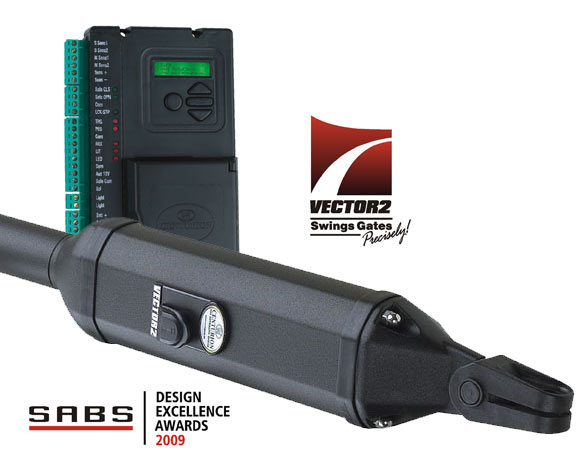
The Virtues of the VECTOR2

The Virtues of the VECTOR2


Innovation distinguishes between a leader and a follower” – Steve Jobs
The VECTOR2 linear swing gate operator is, to put it bluntly, a leader. It leads (confidently, one might add) in terms of design, in terms of intuitiveness and in terms of ingenuity. Let us not forget that not too long ago swing gate motors still relied upon micro-switches for position control and offered precious little by way of functionality. If you wanted any special features such as an extended automatic closing or a wider pedestrian opening, you’d have needed to order a custom-programmed microchip.

Archaic!, you say. Barbaric even. Be that as it may, until quite recently swing gate motors were mere pistons working mindlessly to provide only the most rudimentary of automation solutions.

Even in today’s intensely technology- and convenience-driven milieu, very few operators truly stand out in terms of intelligence. 

The VECTOR2, however, is quite different as you’ll soon discover; for within its LCD controller – one that is no larger than an average hardcover novel – is housed the sort ofintelligence that has the power to redefine an entire industry. Every facet of the VECTOR2operator’s firmware has been designed to be intuitive to the point of precognition, even adapting its behaviour to accommodate any hardware variations that it encounters.

What follows are some examples of how the VECTOR2 makes life easier for installer and end-user alike.

 
Imagecenturion ve

It Practically Wires Itself


As a general rule, there is a hard and fast way that any given device needs to be wired in order for it to work and, when it comes to gate automation, incorrect wiring could very well metamorphose your beautiful wrought-iron gate into the world’s frilliest wall.

So, does the same bleak fate then await you, oh VECTOR2 owner, if you happened to inadvertently wire, say, your master motor’s sensor wires to the slave motor’s sensor inputs on the controller? Will the operator start moving drunkenly back and forth, unable to determine whether it is the master or the slave?

Nein.

The VECTOR2 controller is intelligent enough to pick up on this little miscalculation and rectify it electronically, saving you the time and effort of spending countless hours trying to trace the fault. It is entirely possible to mix channels in this fashion without adversely affecting the operation of the gate.

State of the Art Position Control

The VECTOR2 makes use of a double-redundant opto-electronic system for position control which, in layman’s terms, basically means that the controller always knows exactly in which position the operator(s) is/are. So intelligent is this system, that it even counts pulses if the gate is moved with the operator in the disengaged state.

But what is the benefit of this?, you ask.

Well, let’s say that a leaf delay of 20mm  is active because an electric striker lock or mechanical lip necessitates one gate closing before the other. This scenario in itself would not normally pose a problem. 

But imagine, if you will, the following conundrum: your gates have somehow fallen out of synchronisation. Perhaps you were doing some maintenance on your master gate that necessitated disengaging the operator so that you can move the gate around freely by hand. The problem might now arise that the master gate is now closer to the fully closed position than the slave – and remember, with leaf delay enabled the slave always closes before the master.

Or at least, this would have been a problem were it not for the aforementioned opto-electronic system.  In a situation such as this, the VECTOR2 controller will keep the master stationary and move the slave past the master until there is a gap of precisely 20mm of piston stroke between them. Upon this gap being achieved, the master will be activated and the desired leaf delay will be intact. 

Fully Intuitive Setup

Traditionally, the only way to get a motor to reverse direction (i.e. to change from, say, in an inward opening configuration to an outward opening configuration) was to swap the motor wires around; especially in a double-leaf swing installation, this made for rather a hairy setup procedure. Fortunately, the VECTOR2 controller possesses the ground-breaking intuitiveness to automatically detect in which direction the gate should be opening – as well as which gate it should attempt to open first during the setup – and reverse the wires electronically

So space-age is the technology inherent in this controller, that if it is unable to move one gate in either direction, it will automatically detect that perhaps it is trying to move the incorrect gate and not only swap the motor wires electronically, but effectively swap channels! This sort of fully automated process saves valuable time onsite.

In conclusion, one can surmise that the VECTOR2 linear swing gate motor is truly a marvel of modern engineering and ingenuity; its sleek, slim line design, easy-to-install construction and fast operating speed rivalled only by the incredible intelligence housed within its controller.

Photon Sees the Light! Centurion Wireless Infra-red Beam

Photon Sees the Light!


You know that excited, almost electric feeling that’s in the air right before a summer storm on the Highveld? Like every atom and molecule is abuzz with activity, like the very air around you is alive?
Well, I can tell you in no uncertain terms that this was the kind of atmosphere around the CENTURION office earlier today as we prepared to announce the release of Photon – ourbrand new infrared gate safety beams with a wireless transmitter.

Photon officially became available for purchase from CENTURION and its agents on Valentine’s Day, 14 February 2013, a day that will go down in history as the day that automated gate safety became easy.

Image
But before we go into what makes Photon so awesome (and trust us, it is AWESOME), let’s have a recap of why you need gate safety beams installed in the first place. Think of it as Gate Safety 101.

It’s quite simple, really: You wouldn’t drive your car without wearing a safety belt (we hope not, at least), and you won’t jump out of a plane without a parachute, so it stands to reason that you shouldn’t let your automated gate run without putting some measure of safety in place, either. As we have stated in many previous articles and posts, an automated gate – wonderful and convenient as it may be – is still a mechanical system and as such carries with it the risks normally associated with moving parts. 

Infrared beams have been found to be the most effective means of protecting against crushing, dragging and shearing in an automated gate setup. They are relatively inexpensive and are for the most part reliable but, due to the high cost of installing them – a result of having to route metres of cable, often under driveways – many installations have thus far simply gone without. It is also understandable to a degree that many homeowners would be hesitant to have their driveways defaced for this purpose.

That’s where Photon comes in.

As mentioned before, Photon has a wireless transmitter so the only wiring necessary is from the receiver to the gate motor and, with the receiver traditionally being mounted closest to the motor, no digging or tunnelling is required. As Photon’s slogan declares: Simply attach, align and you’re away! 

Photon also boasts brand spanking new operating features such as Installer Mode: a Mode of Operation that makes the installer’s life that much easier by providing a 4KHz tone once alignment of the beams is obtained, taking all the guesswork out of installing beams.

Then there’s also Open Collector Mode, a feature tailor-made for sites where power draw is a factor (think solar powered installations). In this mode, the receiver relay is disabled and switching is done via a transistor, bringing the overall power consumption on the receiver’s side down by about half.

Call 07033992255 now for more information.

Automated Security and Access Control Systems

We sell, install and support all kinds of Security and Access Control systemsImage
Automatic Gate
Gate Barrier
Walk Through Metal Detector
Turnstile Pedestrian Gate
Automated Bollards
Rising Kerbs
Road Blockers
Door Access Control
Automated Sliding Glass Door
Blast and Bullet Proof Glass Laminate

Electric and Fibre perimeter fencing for Oil and Gas, Government, Military and Educational purposes.

Call 08033520812 / 07033992255 or email alarmnigeria@yahoo.com

Image

Gate Barrier / Boom gate Barrier
SECTOR – CENTURION HIGH-VOLUME INDUSTRIAL TRAFFIC BARRIERS
Main features
• Battery backup
• High volume capability
• Rapid boom pole raise (3m version < 1.2sec)
• Smooth intelligent speed control
• High torque boom pole operation
• Robust, durable and slim-line operator casing
• LCD user interface for simple set up
• Onboard NOVA rolling code (KeeloqTM encryption) multichannel receiver with selective delete
• Integrated ChronoGuard timer functionality
Models

SECTOR 3 – Rapid speed high-volume barrier, 3m boom pole
SECTOR 4 – Standard speed high-volume barrier, 4.5m boom pole
SECTOR 6 – Standard speed high-volume barrier, 6m boom pole

Centurion Automatic Gate

We are a Nigerian company offering Automatic gate and Access Control Automation solutions in the domestic and industrial security sectors. We offer security solutions via the use of gate automation, through our relationship with the manufacturing company in South Africa (Centurion);

Image

we are  distributor of Centurion gate operating machine and Centurion range of products. Nevosys Limited supplies and installed Centurion Automatic gate opener in Nigeria.

Centurion gate operating machine offers an attractive security solution especially in the Nigerian environment:

• Reliable and consistent self control security

• Cost effective

• Environment friendly

• Maintenance free

• Silent operation

The cost saving associated with hiring a staff to man the gate post, the possibility of the hired man to fall sick or can’t be trusted absolutely or the quest to take control of your own security, makes the Centurion GATE AUTOMATION system an economically feasible, lower cost, functional option.

In view of the above we hereby wish to propose this machine for your consideration while we look forward to having a successful and fruitful working relationship with you, and hope to receive your patronage.

Call 07033992255 or email us for more info alarmnigeria@yahoo.com

Automatic Gate Operator

Image

Are you a building engineer or into real estate and your clients are asking you for automatic gate opener?

Are you one of those who wish that your gates would just open so that you can drive in automatically with the touch of a button?

Call Nevosys automatic gate experts for an affordable installation today.

Its convenience, long range remote control upto 100 meters range

It’s More Cost-Effective to Implement (N120,000-N200,000) depending on the weight of the gate

This is true for a number of reasons. Firstly, DC devices have only two conductors (namely positive and negative) versus the three (live, neutral and earth) needed for AC equipment. Since DC allows us to operate at much lower voltages, less insulation is typically needed which in turn leads to reduced costs.

Also worth noting is that DC circuits are generally less complex and require less components and yet they provide superior motor control to AC (another benefit – especially from an access automation point of view where one can accurately adjust running speeds for enhanced safety and security requirements).

It can be powered by solar without the need of mains supply
flexible payment plans.

Main features

Battery backup
Potent push force
Intelligent speed control
Rapid and smooth opening and closing
Exceptionally easy system set up via LCD user interface
Onboard NOVA (KeeloqTM encryption) multichannel receiver with selective delete
Multiple operating features including Alarm Modes (a world first)
Integral ChronoGuard timer functionality

Best of all, it is backed by 24 months guarantee when installed by a certified Installer.

Call Automatic Gate Experts today for an assessment of your gate. 07033992255

DC powered Motor

Why We Do Things the DC WayImage

A long, long time ago there was a very heated, very public battle of wits between DC disciple Thomas Edison and his AC adversary, Nikola Tesla. Their feud was what started the age-old power struggle (literally) between direct current and alternating current, and while there has since been numerous accusations that the Father of DC’s character was less than savoury, there can be no doubt that this method of power distribution has made the world a better place(as has AC!).

In fact, DC has made such an incredible impact on the world that it has become a fundamental part of our design philosophy. But why exactly has direct current become the preferred method of power distribution? Why is it that so many appliances nowadays has a built-in transformer and rectifier circuit to change the input AC voltage to low-voltage DC? And why do we at Nevosys bank on it with our own products?

Well, we’ll tell you…

It’s More Cost-Effective to Implement

This is true for a number of reasons. Firstly, DC devices have only two conductors (namely positive and negative) versus the three (live, neutral and earth) needed for AC equipment. Since DC allows us to operate at much lower voltages, less insulation is typically needed which in turn leads to reduced costs.

Also worth noting is that DC circuits are generally less complex and require less components and yet they provide superior motor control to AC (another benefit – especially from an access automation point of view where one can accurately adjust running speeds for enhanced safety and security  requirements).

Reliability and Autonomy

This point is probably a bit hackneyed, but we all know that it’s true. When the Dark Knight does rise (we’re talking about power failures, in case that metaphor was a bit obscure), it’s important that your appliances carry on working despite the sudden loss of mains power.

Direct current makes this a possibility. You’ve all heard the term “battery backup” being used – now, the battery being a staple of DC power distribution – is what allows your gate motor to dutifully carry on serving you even during lengthy power failures.  AC machines can still be outfitted with backup, but it requires costly additions such as DC converters. Backup is native to DC machines.

Lightning Protection

This point ties in very closely with the one above. Since DC operators gives you a mechanism to fairly easily decouple yourself from the main utility grid using solar power and other energy generators, you are effectively putting another level of protection between you and possible lightning damage.

Higher Starting Torque

While it’s true that AC motors produce higher running torque, think in terms of gate automation. What is more important: setting your gate in motion or keeping it that way? If you guessed “setting your gate in motion”, congratulations! You know your stuff. 
DC motors produce superior starting thrust, which is what you need especially if your gate is slightly on the heavy side. Once it’s on the move keeping it that way is, well, automatic.

Improved Collision Detection

DC machines have been found to be more sensitive than their AC counterparts from a collision detection perspective. This is an important feature to have in your automated system, especially if you have kiddies or pets around.

In a nutshell, the load speed profile of DC motors is such that they tend to slow down when obstructed whereas AC motors are synchronous and only slow down when they literally stall against the load. It is quite simply easier to electronically detect a DC motor hitting an obstruction which in turn allows us to apply more sensitive anti-crushing protection.
 
It Allows Us to Operate in the Safe Zone

Edison once notoriously performed a public demonstration involving an elephant to show the dangers of alternating current, but that’s kind of a cheap shot (not to mention utterly inhumane) and we won’t resort to that here. Besides, at high voltages DC can be much more dangerous than AC.

The fact is, the DC we employ in our gate motors is of the low-voltage variety (typically around 12-24V) which means that it is much, much safer than the AC alternative.

Please note that our aim is not to slate AC in any way. On the contrary, one of our most robust operators – the A10 – is an AC mean machine and offers myriad benefits such as a higher duty cycle and improved running torque that a DC unit might not be able to provide. Our goal is simply to provide you with some insight as to why DC is such an important part of our design philosophy.

DOMESTIC AND LIGHT-INDUSTRIAL SLIDING GATE OPERATOR 

 Main features

  • Battery backup
  • Potent push force
  • Intelligent speed control
  • Rapid and smooth opening and closing
  • Exceptionally easy system set up via LCD user interface
  • Onboard NOVA (KeeloqTM encryption) multichannel receiver with selective delete
  • Multiple operating features including Alarm Modes (a world first)
  • Integral ChronoGuard timer functionality

Choosing the Right Gate Motor

Choosing the Right Gate Motor

Let’s say, hypothetically, that you have finally grown tired of your old jalopy and you’re in the market for a new, more reliable, mode of transportation. Naturally, there are a number of factors you would consider and things you would weigh up before finally settling on a car.

Is safety an important consideration for you? Are you in the market for a family sedan or a sports hatch? Are you looking for something with superior fuel economy?

Similarly, when you’re preparing to have your world rocked by the amazing security and convenience provided by a gate motor, there are some things you need to think about to ensure that you get one that’s right for your application. But don’t worry, with some handy tips from your favourite access automation company you’ll be wielding that remote like a magical sceptre in no time.

AC or DC  Image

We’re not referring to the Australian rock band of course (although our gate motors have been known to rock!), but rather to the form in which electric power is supplied to your operator.  AC, or alternating current, means that the gate motor is being powered directly via the 230V mains supply from a distribution board in your house.

DC, or direct current, on the other hand, is a method of power delivery relying on some sort of “power store” such as a battery. You’ll find that the vast majority of our gate motors are DC-operated.

And there’s a good reason for that. Power delivery, especially in Nigeria, is unfortunately quite unreliable, erratic and we’ve all borne the brunt of load shedding before. Your gate motor, being the holder of so many titles – security guard, butler, etc. – needs to be on duty around the clock, and DC units are able to continue operation even during lengthy power failures, whereas AC gate motors are not.

On the flipside of the coin, AC motors have a virtually unlimited duty cycle and will work tirelessly as long as they are being fed mains. Both of these modes of power delivery have their virtues, you simply need to decide which is best suited for your application. If you live in an area where power outages are commonplace, a DC unit is probably the best bet.

Weight of the Gate

Unless you’re an ant or former Governor of California (and sometimes actor) Arnold Schwarzenegger, you probably can’t carry much more than your body weight. But through the miracle of engineering gate motors are able to relatively effortlessly lug around several hundred times its own weight.

But that doesn’t mean it should be unrealistically loaded. Subjecting it to that kind of abuse will invariably lead to problems down the line, so first get an approximation of what your gate weighs before selecting a motor. The good news is that gates are usually much, much lighter than we think. For example, if you can lift one side of your gate to about the height of your shin, chances are it doesn’t weigh much more than 250kg.

Pull Force

This is more an extension of the previous point than a whole new heading. Pull force plays a monumental role in what gate motor you install, and has a direct impact on both the reliability and the service life of the operator. If you struggle to open and close your gate manually, be sure to choose a device rated for a high push force such as a D10.

The easiest and most accurate way to determine the weight of the gate is to use a pull scale as found in any angling goods store.

Swing or Slide

This one might seem fairly obvious if you already have a gate fitted, but if you’re looking to install a gate where there isn’t currently one this might warrant some thought. The truth is that both swing and sliding gate motors are equally rich in merit and which one you choose to fit simply depends on preference or, in the case of an existing gate, what the setup necessitates.

If you are going with a swing gate, remember to take into account factors like the length of the individual leafs, wind loading, etc.

If you follow these few simple selection guidelines you’re assured of a gate motor that’ll faithfully serve you for years to come. And if you do get stuck, remember that our technical support centre is open Monday to Friday from 7am until 6pm. Their number is 07033992255Image

walk through metal detector

Nevosys Limited sells and install a complete line of Metal Detection products for people screening and security at airports, government buildings, schools, church, oil & gas and public facilities. For superior reliability, uniformity, accuracy and enhanced weapons detection, the walk through and handheld metal detection solutions use true digital signal processing and the latest advanced electronics. Call 07033992255 or email us for more info.

18 zones walk through metal detector Nigeria Africa, bomb jammer Ajah, walk through metal detector Victoria Garden City, Super scanner kogi, ring scanner victoria island, hand held scanner VGC Lagos, super wand detector Africa, garret scanner abuja, 6 zones walk through scanner KANO, bomb detector IBADAN, explosive detector PORT HARCOURT, metal detector ZARIA, bomb jammer Nigeria, walk through metal detector osborne estate, Super scanner abuja Nigeria, ring scanner Lagos, hand held scanner Victoria Garden City Lagos, super wand detector Jos, garret scanner Maiduguri, 6 zones walk through scanner Borno, bomb detector Nassarawa, explosive detector Kano, metal detector Mina, 2 zones walk through metal detector Kaduna, bomb jammer Bauchi, walk through metal detector Kastina, Super scanner Sokoto, ring scanner Gauso, hand held scanner Kebbi, super wand detector Yobe, garret scanner Jigawa, 6 zones walk through scanner Onitsha, bomb detector Lagos Nigeria, explosive detector Abuja, metal detector Plateaui, 2 zones walk through metal detector Louis Edet House,Image